
The Bengali New Year, known variously as 'Poila Boisakh' or 'Noboborsho,' begins in the middle of April. The Whitaker's Almanack lists seven key Indian calendars viz., the Kaliyuga, the Buddha Nirvana, the Vikram Samvat, the Saka, the Vedanga Jyotisa, the Bengali San and the Kollam calendars. Apart from these, there exist several others. Many Indian calendars begin in Spring – very close to the vernal equinox: the Bengali San, for instance.
The modern Bengali calendar (the Bengali San) was influenced by the Tarikh-ilahi, a solar calendar, which was introduced by the Mughal Emperor Akbar in 1584. Akbar's ecumenical approach to theology and religion (he founded the syncretic religion Din-i-ilahi or the 'Religion of God') was rather congruent with his attempt to harmonise various local calenders into a unified almanac. Although the Tarikh-ilahi was offcially founded in 1584 CE, its zero year is the same as that of Akbar's coronation i.e., 1556 CE. Unlike the Islamic HIjri which is a lunar calendar, the Tarikh-ilahi was conceived as a solar calendar. Interestingly, this also makes way for a parallel theory that the primary rationale for the promulagation of a brand new solar calendar was the collection of land revenue. Since the Islamic Hijri calendar was lunar, it did not follow the seasons making the collection of land revenue, at best, erratic. However, the Bengali solar calendar was adjusted to the Islamic Hijri with reference to the zero year of the Tarikh-ilahi i.e., 1556 CE (Hijri 963/ Saka 1478). In the newly conceived Bengali San, Saka 1478 was thus dated back to 963 although, it did not adopt the lunar counting system. The lunar year being shorter than the solar year, the Hijri has naturally marched ahead while it's still just the 15th century according to the Bengali San.
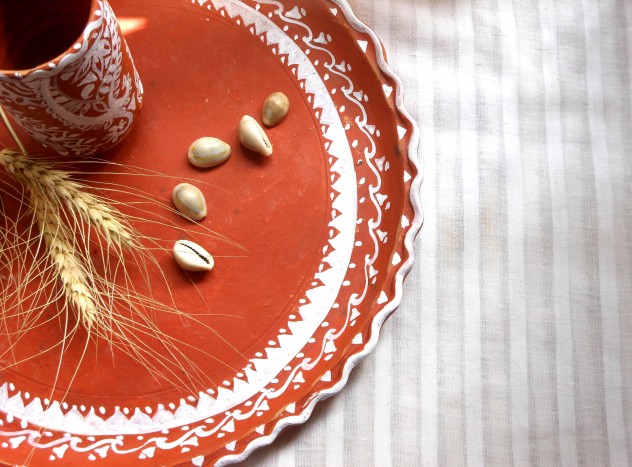
So much for the history of almanacs and calendars! The 'Ponjika' or 'Paanji' has a special place in the Bengali household. The average Bengali 'bhodrolok' (gentleman) or 'bhodromohila' (lady) would waste no time in procuring this slim pink volume enumerating the correct procedures of various rituals and religious ceremonies together with details pertaining to planetary aspects, eclipses etc. well before Poila Boisakh – the first day of the new year.
Although April is getting warmer with every passing year, the Bengali gastronome gives a damn to the weather. There is no question of missing out on the maach, mangsho (this most certainly means mutton, NOT [the paltry] poultry) or mishti. To hell with the gorom (the soaring summer temperature which can rise well above 40 degree Celsius right in the middle of April)!
Phew!
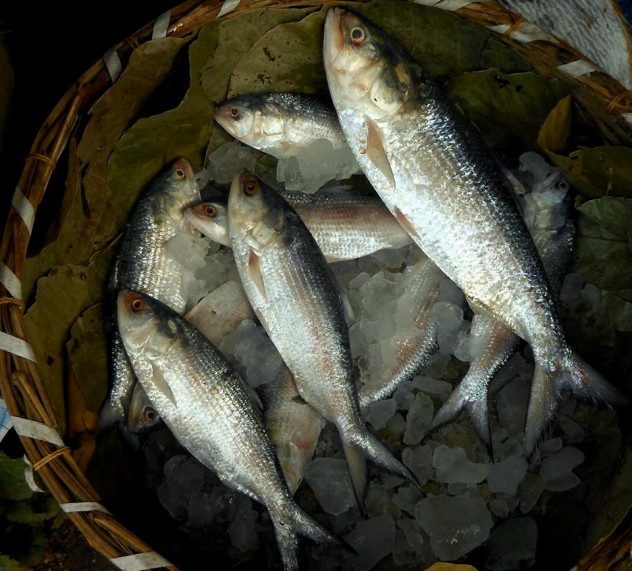
The iridescent Hilsa
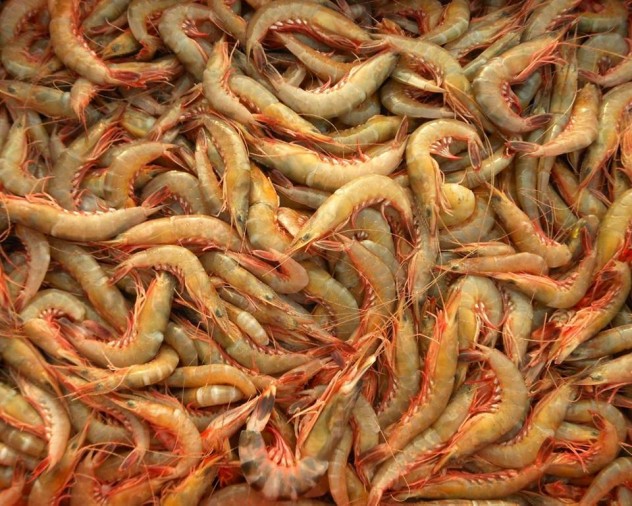
Fresh Prawns
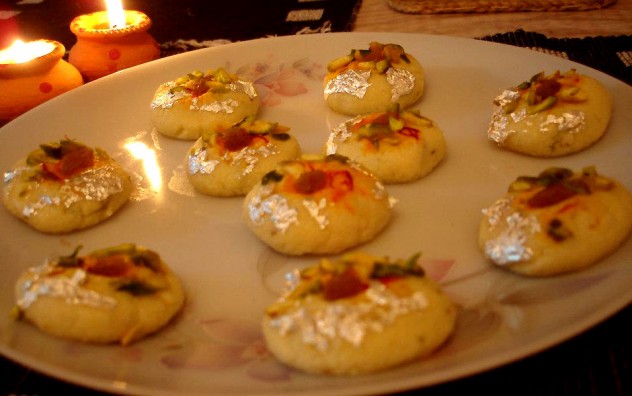
Dieting is a travesty to the Bengali-at-heart (and so I believe it is to the Punjabi-at-heart). Furthermore, the Bengali's relationship to food is marked by a strong amorous accent. Be it the luminous bhapa ilish (steamed hilsa) or the radiant golda chingri-r malaikari (jumbo prawns cooked in coconut milk) or the luscious, syrupy roshogolla (the signature sweet of Bengal), the Bengali gourmand/e relates food not merely to appetite but to an intense desire to savour the voluptuous flavors and aromas of a meal. So what if the shukto is bitter? For the unmistakable bitterness of the korola (a vegetable belonging to the cucurbitae family) is only a ruse – a cleverly-devised smokescreen – subtly enhancing the finer nuances of a rapturous mélange.
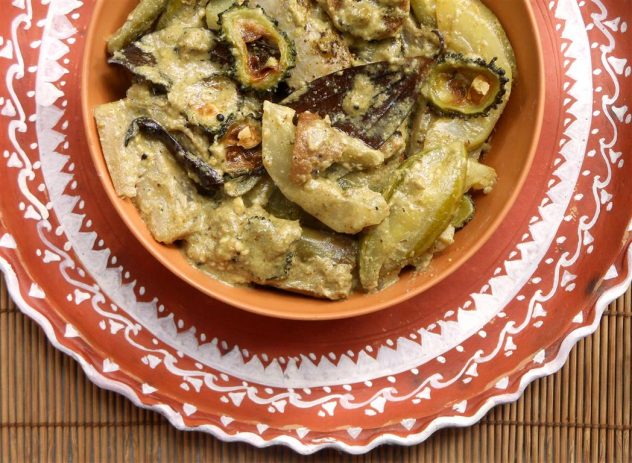 Shukto
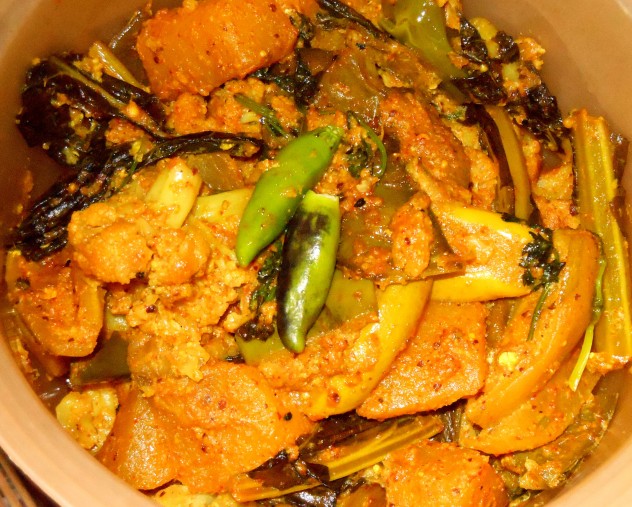 Chochchori cooked with cauliflower (by April, cauliflowers are almost out of season but, if available, are always up for the grab) florets and the tender green stems along with potatoes, brinjal, pumpkin, daikon radish and broad beans. Flavored with freshly ground mustard paste, green chillies and coriander leaves.
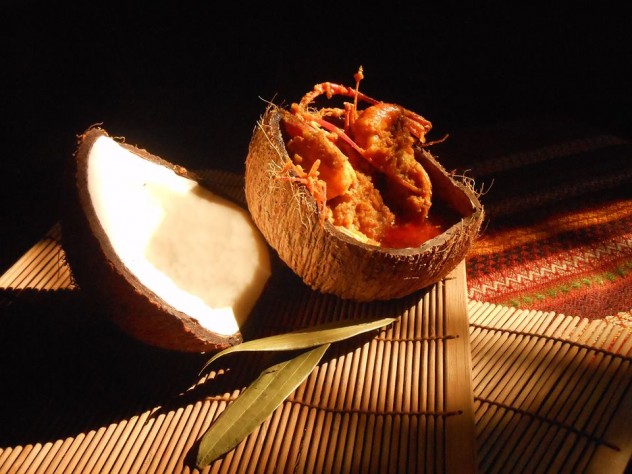 Chingri-r Malaikari
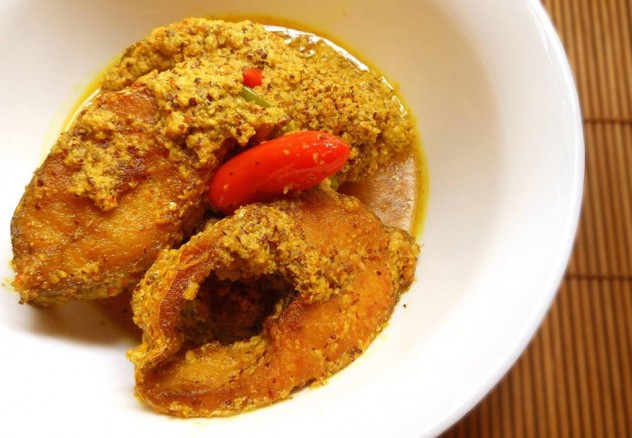 Bhetki Maacher Paturi (Freshwater Bass cooked in pungent mustard oil and freshly ground mustard paste. Seasoned liberally with green chillies)
Even though there seems to be no prescribed list of dishes for 'Poila Boisakh', the menu tends to be devised along a basic framework comprising rice; a starter (often bitter: the shukto); a lentil soup or dal (both vegetarian & non-vegetarian variants are in vogue), fritters (or, bhaja); one or two seasonal vegetable side dish(es) (green/unripe jackfruit curry, stuffed pointed gourd, chochchori etc.), fish (in all its glory: jhol, jhaal, paturi, steamed, kalia etc.), meat (mainly mutton; although poultry is also prevalent), chutney (at the time, usually of green mangoes); mishti (roshogolla, sandesh, chomchom – you name it) and mishti doi (sweet Bengali yogurt), of course!
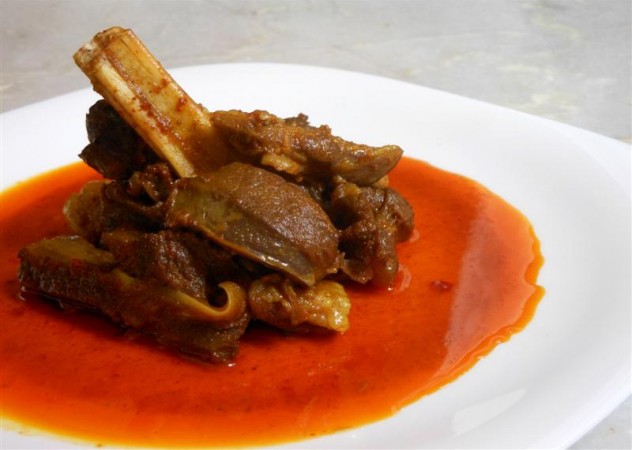
The good old Mutton Curry cooked with freshly ground fiery red cayenne pepper.
Although creative improvisations (read, 'fusion cuisine') on the new year fare and the inclusion of an ever-widening array of flavors are fast catching up, there's no beating the traditional Poila Boisakh banquet.
And so, if you happen to be in Bengal around the new year and your host also happens to be a jolly good Bengali gourmand/e, do not think twice in giving all the fancy party places a miss. Sure thing, you won't regret!
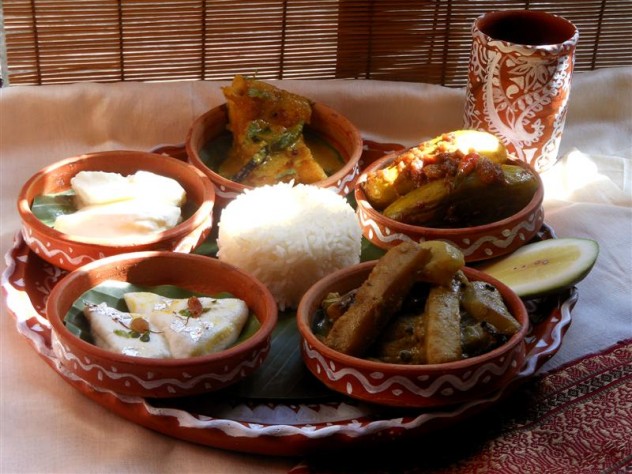
Shubho Noboborsho!







0 comments on “The Vernal Feast of the Bengali New Year”Add yours →